
The type of PMO depends largely on how mature project management is in the organization and which goals the PMO is meant to achieve.
Having already defined the term PMO, we now explain the different types of project management office.
After all, the P can stand not only for project management, but also for project, program or portfolio. In addition, there is the PMCoE and the PSO. But one thing at a time.
Overview of the Types of PMOs
PO – The Project Office
Put simply, the project office (PO) is the overarching coordination unit for a single project. Like a PMO, it can take on a directive, supportive or controlling function, but only for this one project.
A PO is typically set up to provide support for extensive, complex change projects for the duration of the project. A PO is therefore temporary.
One example is setting up a permanent PMO: the PO dissolves as soon as the PMO has been introduced and established in the organization. This article explains the difference between a PO and a PMO in detail.
PSO – The Project Support Office
As the name suggests, the PSO provides operational and administrative support for individual projects in the organization. Its function is purely supportive: it takes on tasks such as training to increase project management maturity, creates templates or handles capacity planning for resources.
A PSO is typically a permanent organizational unit. In multi-project management, the PSO can also be part of a PMO, or part of the PO if it supports a single, highly complex project.
In agile organizations, a project support office can also manage agile artifacts and support Scrum Masters or Product Owners with organization or communication.
The PSO can therefore exist as a permanent or temporary organizational unit.
PMO – The Project Management Office for a Department or the Entire Organization
The project management office can act in a directive, supportive or controlling role and perform this function either for one department or for the entire organization. Depending on the project management framework the organization follows, the PMO is set up only temporarily (PRINCE2), established permanently (PMBOK Guide, IPMA ICB 4.0) or can be temporary or permanent depending on the needs of the organization or project (PM² standard and ISO 21502).
The organization-wide PMO also differs from a PO and PSO in that its overarching goal is to align the entire project landscape with the corporate strategy. If the PMO is set up “only” for one department, strategic alignment can be the goal here, too. However, its effectiveness will be lower if other departments have no PMO or even actively resist it.
PMO – The Program Management Office
A short detour into the definition of program management: a program is a collection of projects whose content is related. Managing these programs aims to use the synergies and dependencies between the projects to achieve better results faster together.
If the P in PMO stands for program, it is the organizational unit responsible for the programs in the organization, in a directive, supportive or controlling role.
A program management office is typically permanent. Organizations that have one have a high level of project management maturity and are aware of how important it is to align programs with corporate goals.
PMO – The Project Portfolio Management Office
Here, too, a short definition first: a project portfolio is a collection of projects and programs.
Only projects and programs that match the organization’s strategic goals are included in the portfolio, prioritized and steered by the project portfolio management office in its directive, supportive and controlling role. This is the key difference from a project management office, which can be directive, supportive or controlling. A project portfolio management office has to combine all three in its function.
A project portfolio management office is typically permanent and reports directly to the CEO or the executive board.
PMCoE – The Project Management Center of Excellence
The PMCoE is a kind of think tank for project management that organizations set up specifically to increase their project management maturity. Unlike a PMO (whether the P stands for project, program or portfolio), the PMCoE has a purely advisory function. It is not directly involved in projects, but addresses project managers and project team members.
A PMCoE is typically set up as a permanent organizational unit and takes on tasks such as developing and maintaining project management guidelines, building a knowledge base with best practices, or digitalizing project management by selecting project management tools.
Project Management Maturity Shapes the Type of PMO
An organization’s project management maturity has a direct impact on the type of PMO. It’s a bit like children and bicycles: you wouldn’t teach a two-year-old to ride on an adult bike. In the same way, project teams won’t appreciate a project portfolio management office if they haven’t yet mastered the basics of project management.
Accordingly, the list of PMO types above can be read in ascending order of maturity. A PO requires a lower level of project management maturity than a project portfolio management office.
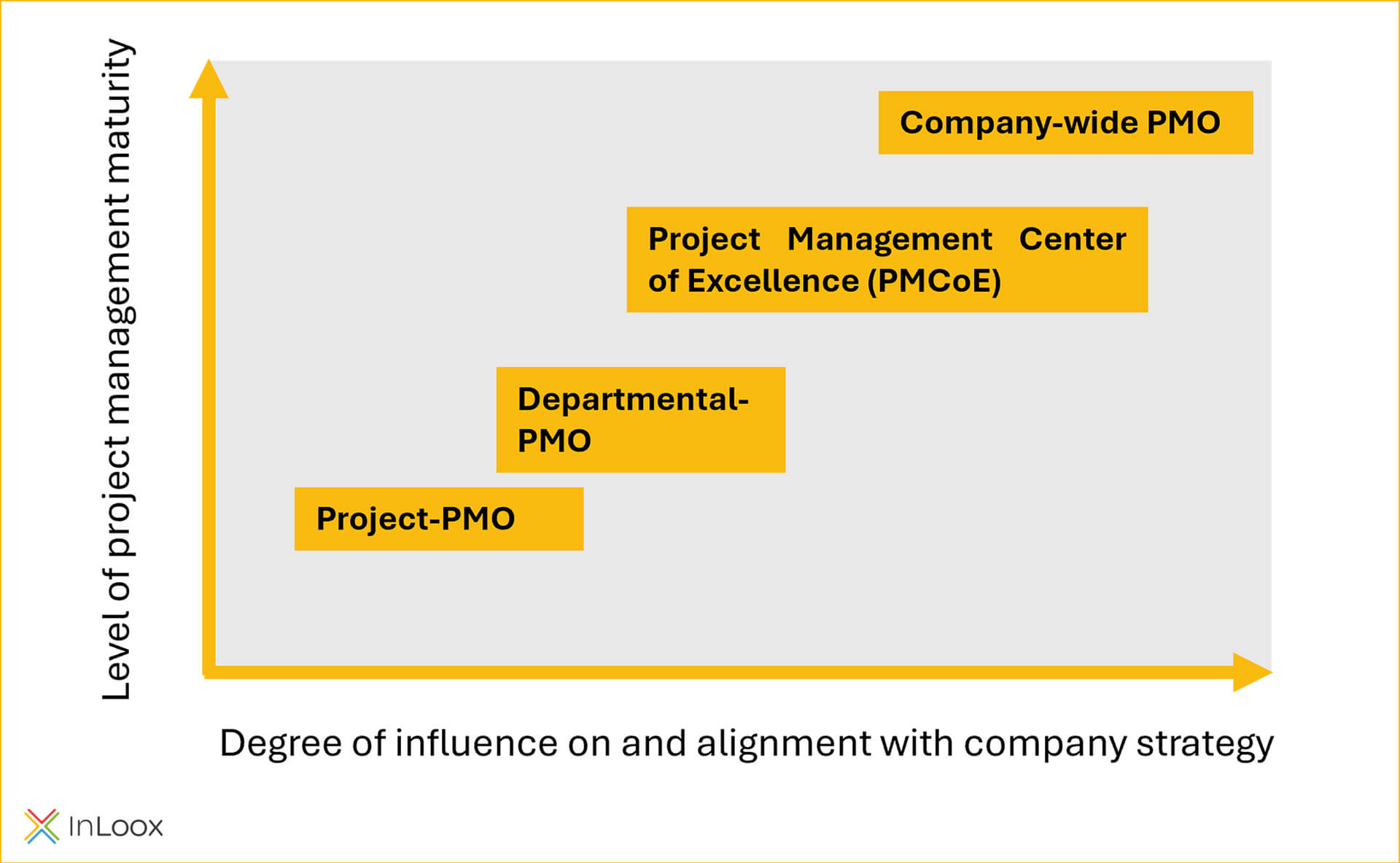
Figure: Project management maturity determines influence and strategic alignment. ©InLoox GmbH
The PMO in the Organizational Chart
Depending on its type, the PMO is anchored at different points in the organization. While a PO is attached to a project, a departmental PMO is anchored in the department. Organization-wide PMOs, by contrast, sit under executive management, the C-level or the board.
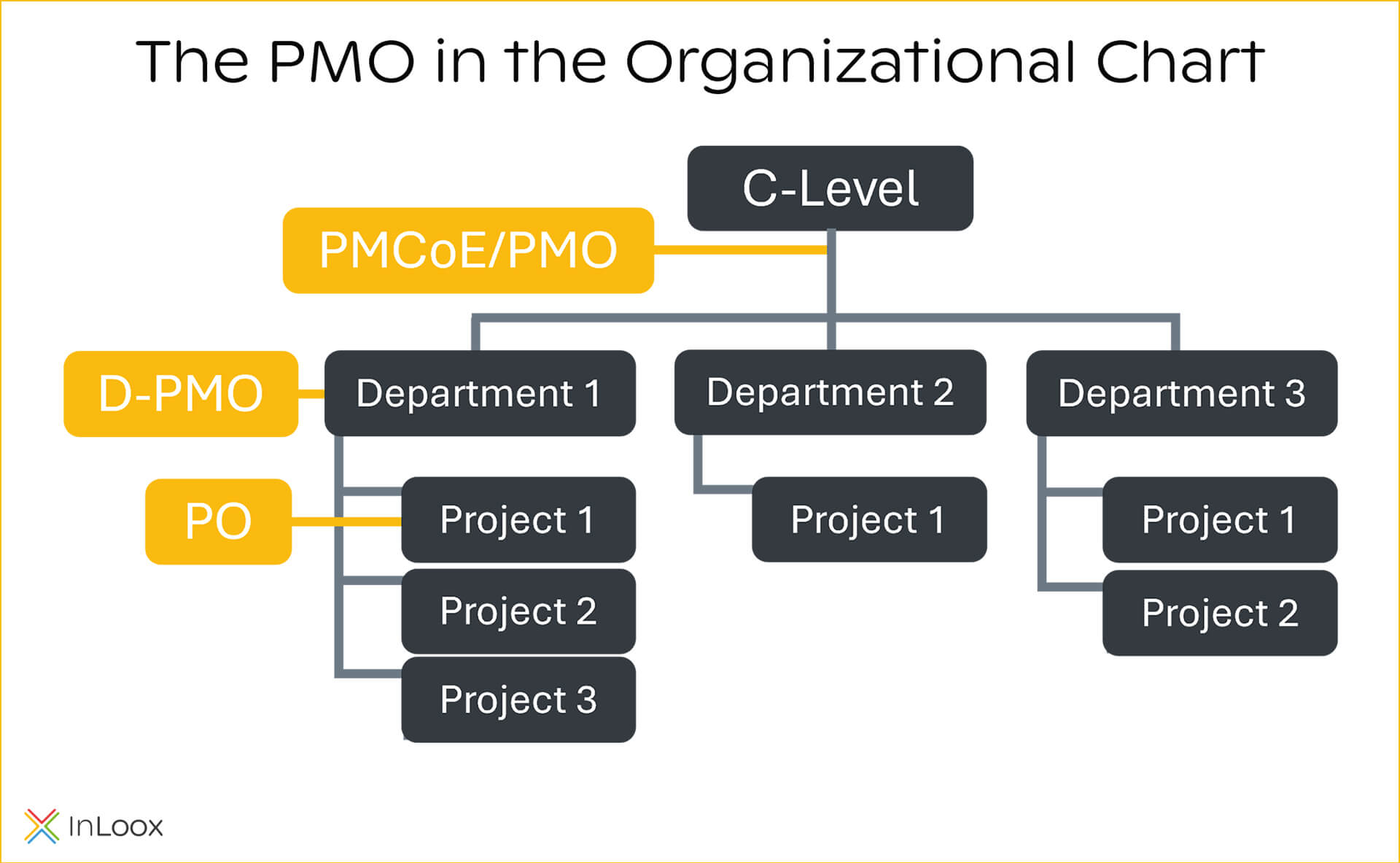
Figure: Position in the organizational chart depending on the PMO type. ©InLoox GmbH
The next article in this series explains how to implement a project management office and what influence a successfully established PMO can have on the organization.
Read the other articles in our PMO series or use our detailed whitepaper on implementing a project management office
- PMO 1: Definition and Function of a Project Management Office
- PMO 2: The Most Important Project Management Office Roles
- PMO 4: Implementing a Project Management Office
- PMO 5: The PMO as the Driving Force of Agile Transformation
- Whitepaper: Implementing a Project Management Office
Note: This article was last updated on July 31, 2025.