

You might not be trained in project management, but you sure do have to do project based work at some point in your career. Almost every job in today's competitive business environment entails some degree of project management and even those among us who are not project managers by education have to use the skills of a project manager. This is largely due to the great diversity of the project management discipline. A great variety of industries and professional fields specifically ask for project management skills, and attaining such skills can result in a real career boost. We compiled information to help you get a better idea of what project management entails, who's involved in a project and their respective responsibilities, as well as common challenges that are faced in project management and decisive factors for successful project delivery.
What is a project?
In order to get a better understanding of what project management entails, we first have to define what lies at the core of project management: the project. A project is commonly understood to be
- a temporary, one-time collaborative endeavor
- that requires careful planning and coordination
- has a defined beginning and end within time constraints
- has only limited resources available
- aims to achieve defined target results
According to the PMBOK Guide of the Project Management Institute, a project is defined as follows:
“A temporary endeavor with a beginning and an end that is undertaken to create a unique product, service or result.”
In addition, it is progressively elaborated. This definition of the term “project” means that projects are activities that cannot go on indefinitely and must have a specific purpose.
A project is an activity that serves to create a product or a service. Activities carried out to complete routine work therefore cannot be considered projects.
Keep in mind that the term “temporary” does not refer to the result or service that the project produces.
The project can be temporary, but the result does not have to be. A project to build a monument, for example, would be temporary. The monument itself can last indefinitely.
Finally, a project must be progressively elaborated. This means that the project advances and continues in small steps. The definition of the project is refined with every step and the purpose of the progress is announced.
What are the basic phases of a project and what is their purpose?
1. What is project management? – A brief definition
Project management is the discipline of planning, managing, organizing, and monitoring all project related tasks as well as guiding everyone involved in the project. There are a variety of techniques and methods that project managers can use to drive their projects to success. Apart from the methodological aspect of project management, there is a wide range of skills a project manager should bring to the job. Read more on what makes a good project manager.
2. What is the project management triangle?
Like most undertakings, projects need to be performed and delivered under certain constraints. Traditionally, these constraints are referred to as the three sides of the “project management triangle”: time, cost and scope. All project management parameters draw on the same resources and therefore, changing one side of the project management triangle inevitably will affect the other sides. The project manager has to ensure a reasonable and balanced allocation of all resources for successful project management.

3. The different project roles

Project management is typically a team effort. The project management team, consisting of team members and the project manager, joins forces to meet unique goals and objectives. According to project experts, a team size that exceeds seven members is not advisable. When managing large-scale projects, it can be helpful to divide the project into smaller scope sub-projects. This reduces some of the complexity of project management because it allows project teams to focus on a smaller project scope. All project teams, no matter which sub-project they work on, report to one project manager who is responsible for the overall project success.
Ideally, the team members not only have solid professional expertise but also strong project management skills. Completion of tasks such as project communication and giving feedback on project progress are essential for successful project completion. Another critical aspect to project management is the assignment of project specific roles to the team members. Everyone involved in the project should know what their specific tasks and responsibilities are.
Project managers are accountable for achieving the stated project goals. Their key responsibilities are the careful planning and management of the triple constraint (time, cost, scope) to ensure a successful project closure. Additionally, project managers need to ensure project quality and keep an eye on potential project risks. In many cases, project managers have only task-related authority but lack managerial authority over their team members which can make successful project management more difficult.
Apart from their professional knowledge (subject matter experts), project managers should be proficient in project management. In order to succeed in project completion, it is essential that they are effective problem solvers, have excellent team building and leadership skills as well as a strong ability to clearly and concisely communicate.
The wider circle of stakeholders within a project includes initiators, clients, external partners (e.g. consultants and service providers) and others including all internal and external interest groups such as administrative institutions as well as trade unions.
While once delegated to a function within other jobs, project management now is even a distinct career itself – and one of the most famous interdisciplinary professional careers, too. According to the Project Management Institute (PMI), project managers enjoyed a very healthy job market in 2020 and prospects of future growth(Source: PMI's Project Management Salary Survey 2020). High-tech industries have especially bright prospects when it comes to careers in the project management field. The field of project management not only is an attractive one from a career standpoint. A 2014 GPM research study showed that project based work leads to a high work satisfaction rate among employees.
4. Project management techniques and methods
Project management methods and strategies can be divided in two major, greatly different approaches: the classic approach and the agile approach.
Overview: Which project management methods are there?
We have listed the top 10 project management methods here:
- Kanban
- Waterfall model
- Scrum
- PRINCE2
- PMBOK
- Lean
- Six Sigma
- Critical path method (CPM)
- Critical chain project management (CCPM)
- eXtreme Programming (XP)
A classic approach to project management: The waterfall planning model
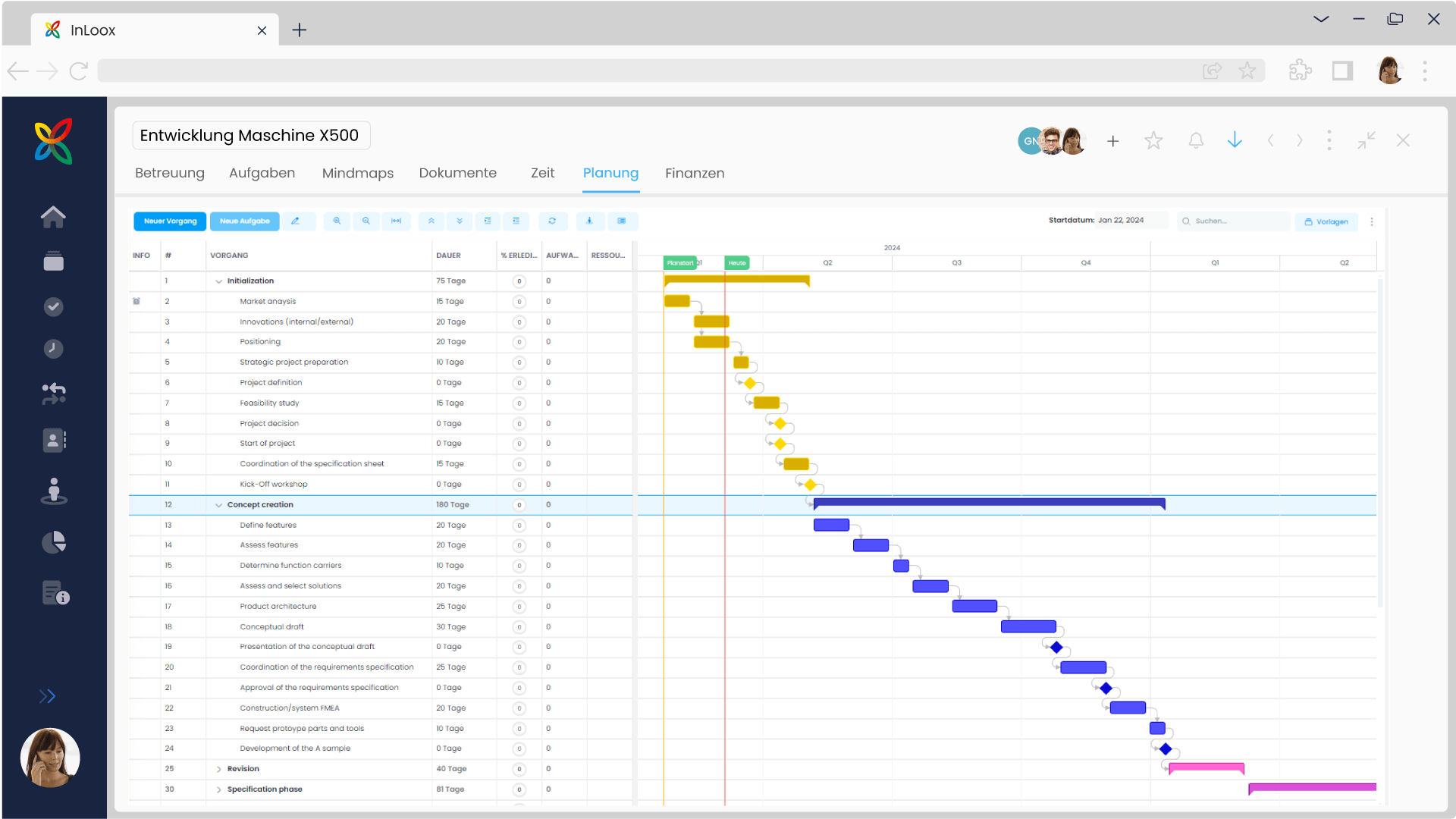
Classic approaches to project management are the waterfall model, bar charts and PRINCE2. They are based on the assumption that a very precise definition of project goals is the fundamental basis for project success. Therefore, classic project management approaches require very detailed forward planning of all project related activities, logical dependencies and chronological sequence of all meetings, deadlines and milestones.
Example for an agile approach to project management: Scrum
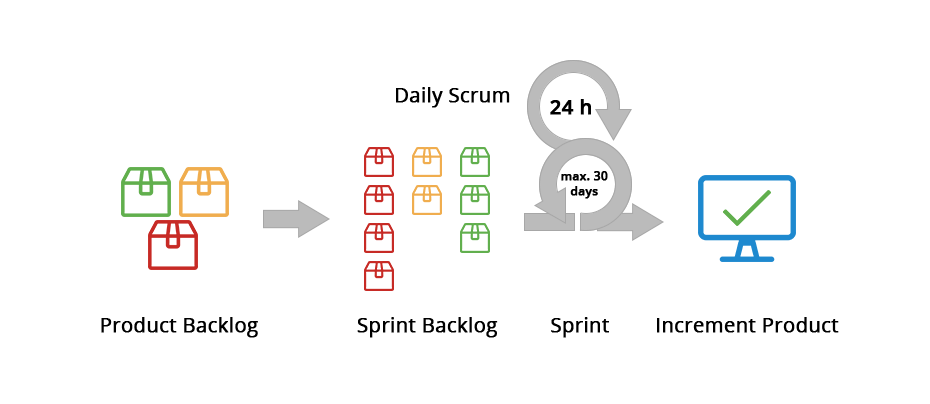
The agile approach to project management is rooted in the field of software development but has been used more and more in a variety of industries.
The underlying principle of agility is the iterative process. When employing agile project management methods, it is essential that the project target allows room for divergence. This project management method can only be successful if all stakeholders can agree on a flexible – therefore agile – project plan. At regular intervals, the client receives a fully working intermediate product (or increment product), allowing for continuous monitoring of the product development process because the client can give feedback early on. Based on the insight gained from the client’s feedback, the project manager can adjust the original project plan and the newly gained knowledge can be used already for the next intermediate product. In the meantime, both contractor and client can reassess their project goals and adjust them according to the changed project conditions.
When it comes to project management, there is no one best approach. A great number of factors such as the corporate environment, all stakeholders and the project target are only a few of the factors that need to be taken into consideration when choosing the project management approach and method. So-called hybrid project management approaches combine elements of classic and agile project management methods. Depending on the project phase and activity, it can be best to apply different project management methods just like picking the right tool from the toolbox for each job.
5. The importance of project communication

One of the most important success factors in project management is a well-functioning communication concept. There are a great number of reasonable ways to make project information accessible to team members. Especially with complex projects, it is essential to structure information well, preventing information overload and making sure that the required information is actually delivered to the recipient.
Some important communication channels are status-meetings with all stakeholders, telephone and video conferences. Project related documents should record all relevant information and decisions. Project management can benefit from borrowing knowledge management techniques: Wikis, for example, are great tools to collect and exchange information. When it comes to project communication especially, using project management software can be very helpful. With the aid of project management software, the multitude of project information can be easily structured, processed, and delivered.
A project management tool that is integrated into existing systems, meaning those the project team uses all the time anyway, such as Microsoft Outlook, can be particularly helpful for improving project communication.
6. The project lifecycle: A step-by-step guide
Depending on the project phase and progress, project management entails a variety of tasks:
Phase 1 – Project preparation
- Project idea
- Project goal
- Project charter/order
- Project description
- Project scope (Duration, cost, manpower, content)
- Project finances
- Contribution to corporate value generation
Phase 2 – Project planning
- Task planning
- Timing and scheduling: Definition of milestones and deadlines
- Resource planning
- Budgeting
- Risk analysis
Phase 3 – Project start
- Kick off meeting
- Transferring responsibility to project leader and team
Phase 4 – Project realization
- Monitoring project progress
- Team leadership
- Performance evaluation
- Controlling
Phase 5 – Project closure and analysis
- Final report
- Final meeting
- Evaluation
- Lessons learned
- Project archiving
7. Parameters for project success
The Standish Group regularly publishes the Chaos Report, providing statistics on project management success and failure. One of the key success factors in project management is a professional project infrastructure. Executives commonly believe that projects can be managed on the side when in fact project management is a demanding full-time job. Installing professional project management control and monitoring instruments significantly increases the chances of success. The higher the project management maturity in an organization is, the higher are project success rates.
Every project should have a clear goal that adds substantial value to the company. As banal as it may sound, a great number of projects are initiated and realized merely for reasons of prestige. The project plan should include fixed deadlines and a financial framework as well as counter-measures in case those limiting factors are overrun. Defining critical project factors is essential for the success of any project and continuous changes to project parameters can negatively affect the project outcome.
In addition to the internal factors, project management is greatly influenced by a variety of external factors. A project’s success greatly depends on its acceptance and support from the corporate management. The successful completion of a project is endangered if the executive level (c-level) and other stakeholders do not or no longer back the project. Successful project management also strongly depends on the overall project infrastructure. The project team can only work at its full potential if all relevant project management resources are available, e.g. equipment and facilities.
Challenges in project management
Only seldom can project managers rely on manpower that is exclusively dedicated to their project. Typically, team members have to fulfill their project tasks on top of their regular responsibilities within their departments, complicating the project manager’s tasks. Other common challenges associated with project management are the organization of data and information as well as ensuring that every project worker is kept up to date on project progress and deadlines. The cost constraint requires close monitoring of the project budget and keeping it under control. In order to have a good idea of the specific challenges, project managers should do a project risk analysis.
Here are 7 typical project management challenges:
- Missing or insufficient project planning: undefined processes, missing project roadmap etc.
- Missing clearly defined rules, e.g. communication and feedback channels aren't defined
- Project plans are too complex because of the project size
- Inefficient resource allocation
- Chaotic project documentation: project documents and information are scattered
- No lessons learned or retrospective
- No project management tool or using the wrong tool
8. Advantages of professional project management
The fact that a company has set up professional project management is often already one of the most important success factors in a project.
Nevertheless, project management is often dismissed as unnecessary bureaucracy, on the grounds that tasks could be completed much faster without the tiresome documentation. What is often forgotten is that companies today face constant pressure to innovate, constant competition and constant change. To meet these challenges and respond quickly to change, a project-oriented corporate culture is advisable.
The following arguments also speak for implementing professional project management:
1. Reduced project effort
Implementing project management anchors systematic procedures and clearly defined processes in the company. This reduces revision loops, duplicate work and coordination effort. Project management therefore reduces the overall effort of projects.
2. Faster turnaround times and higher profit
Less effort for handling projects also frees up capacity. As a result, more projects can be handled in the same time, because skillful multi-project management ensures faster turnaround times. If more projects are carried out with the same funds and resources, this also contributes to higher profit.
3. Transparency
Consistent project management creates transparency, both internally and externally. Everyone involved can get a quick and easy overview of the current status of the project at any time, because the course of the project, the responsibilities and any delays to the end date are clearly documented. The project goals are also recorded transparently for all stakeholders and shareholders.
4. Clear responsibilities and commitment
In addition, conflicts such as power struggles can be reduced. At the beginning of the project, the individual roles in the project team are defined, and ideally each task is assigned to exactly one resource. This way, nobody can hide behind their colleagues and hope that “they will take care of it”. Every project team member is bindingly responsible for their tasks.
5. Better schedule adherence
Project management provides numerous tools for better planning or better controlling, monitoring and evaluation in order to increase schedule adherence from project to project (e.g. phase-milestone planning). On-time completion not only improves a company’s image, it also increases the likelihood of repeat orders and reduces interest as part of the financing costs.
6. Early warning system
Many project management methods support the early detection of bottlenecks and risks: project environment analysis, risk analysis, milestone trend analysis and so on. With these tools, project managers always have relevant risk factors in view and can react to problems in time.
7. Greater competitiveness
Strategic project management optimizes and supports the core tasks that keep companies in business: the rapid and continuous expansion of competitive advantages and the constant improvement of products, processes, services and technologies.
9. Advantages of project management software
Every project that has more than two team members regularly requires a tremendous amount of communication and coordination. Common questions of alignment are:
- Who completes what tasks by which deadline?
- What work package or task and activity has already been completed?
- Should delays be expected?
- Which is the current version of a project related document?
The manual distribution of project related information often times leads to errors. Important team members and project stakeholders can easily be overlooked in the communication process if information is forwarded via phone and email. A certain degree of automation is helpful in streamlining the project management process. Project management software can be of valuable service, supporting the whole project team on a daily basis. A growing number of project teams are in search of a comprehensive project management system that is an adequate alternative to Microsoft Project. Aided by a suitable project management software even complex projects remain transparent and easily manageable, leaving more time for the all decisive operative tasks.
10. Project Management – FAQs
What is project management?
Project management encompasses all tasks related to the planning, management, organization and control of projects. The task of project management is to balance the factors of time, cost and scope of a project so that the project can be successfully completed. Read on »
What is project management for?
Project management helps teams to implement projects faster and more successfully so that products and services can be brought to market more quickly. Faster throughput times due to reduced project costs lead to an increase in profits and competitiveness. Read on »
What is the magic triangle in project management?
The magic triangle is made up of the three parameters of time, cost and scope or quality. These three factors are in constant competition with each other and it is the project manager's task to manage the project so that it is completed within the agreed time frame, budget and scope. Read on »
What are the roles in project management?
In project management, a team usually consists of the project manager and the project team. There are also a number of internal and external stakeholders (project participants) who have an interest in the success of the project. Read on »
What is the importance of project communication?
Project communication is one of the most important factors for successful project management. In addition to standardized communication rules, collaboration and project management tools can support project teams in communicating with each other more efficiently. Read on »
What are the project phases?
There are five project phases in project management: Project preparation, project planning, project start, project implementation and project completion. Different tasks are involved in each phase. Read on »
What are some project management methods?
A distinction is often made between classic and agile project management. Classic project management methods include waterfall planning, for example. A popular agile approach, particularly in software development, is Scrum. Read on »


Try project management with InLoox for free
Plan and manage your projects in InLoox: with Gantt charts, Kanban boards and dashboards.
Start your free trial
Name
Please enter your name.
Business email
Please enter a valid email address.
Something went wrong. Please try again later or contact support@inloox.com.
Prefer to talk first? Book a consultation
Already have an account? Sign in