
Employees often know their processes, customers and problems better than anyone else. Here’s how to turn that knowledge into new ideas: with Innovation Labs, lateral thinking, pitching contests, Innovation Digging and the Walt Disney method.
Established companies are under increasing pressure to innovate. Customer needs are a good source of new ideas, but they are not the only one. A second source is right inside your company: your employees. They often have the best ideas and the necessary know-how. Still, many companies are skeptical, because letting employees develop ideas means giving them time to do so during working hours. This article shows why it pays off and which methods help.
Innovation and Creativity: What It’s About
Innovation is often defined as the new developments associated with technical, social and economic change. This includes completely new developments as well as the improvement or redesign of existing products and services. There is no uniform definition of creativity. It is often described as the ability to think and act in an imaginative and creative way. In this context, being creative means being able to actively shape innovation.
Why In-House Ideas Pay Off
Every employee is an expert in their own field: they know best which problems need solving and often already have a suggestion. First ideas can be collected quickly and cheaply, for example by email or with an idea box. Truly productive idea development requires a bigger investment, but it will pay off.
Employees benefit, too. Being invited to give feedback and contribute makes people feel heard and appreciated, and being allowed to help shape the company’s development is highly motivating. Developing ideas together improves communication between departments and breaks down silo thinking. Team spirit grows, staff turnover falls, and the company becomes more attractive to skilled professionals and managers.
Broadly speaking, there are two ways to generate ideas: open spaces such as the Innovation Lab, where employees can be creative without being steered in a particular direction, and techniques that deliberately trigger and develop ideas.
Innovation Labs: Room for New Ideas
An Innovation Lab is a physical or virtual space where ideas are generated, tested and implemented. It is usually separated from the rest of the organization so you can start with a clean slate. Ideally, creative minds work together in changing constellations and test their ideas right away as prototypes, for example with a 3D printer. The aim is to combine the know-how and financial strength of an established company with the mentality of a start-up: flat hierarchies, fast communication, short decision paths.
Besides such internal think tanks, there are incubators in which companies support external start-ups with knowledge and capital (Open Innovation). For ideas from your own ranks, the think tank is the right model. The key question is how the ideas find their way back into the company: ideally through a direct line to senior management, or at least through contacts who know start-up culture and are open to new ideas.
To keep the lab from becoming an empty shell, you need the right innovation culture:
- Freedom and flexible hierarchies: Employees need time and space alongside their daily work, because hardly anyone is still creative after a full working day. Constructive criticism must be explicitly welcome.
- A spirit of experimentation: Encourage changes of perspective, mix teams and invite people to connect familiar things in new ways.
- Tolerance: Ideas only make it to the table if no one has to fear failure. Make it clear that a failed attempt has no serious consequences.
The key is finding the right balance: enough freedom for employees and, at the same time, regular exchange so that good ideas are actually used in the company.
Lateral Thinking: Training Creativity
Many people claim to be either creative or not creative. To a certain extent, however, creativity can be learned and fostered. Even simple exercises help, such as using your “weak” hand more often and brushing your teeth with your left hand instead of your right. In companies, new approaches emerge above all where people with different backgrounds work together: experienced employees with young talent, different departments, different cultures.
If you want to foster creativity in a targeted way, for example in a workshop, you can choose from numerous techniques, from mind mapping to the SCAMPER method. One of them is lateral thinking as described by Edward de Bono: deliberately thinking outside the box, illogically and unconventionally. Four principles guide it:
- Recognize dominant patterns of thought
- Deliberately look for other ways of seeing things
- Break away from strictly rational, logical thinking
- Make deliberate use of chance
Not every step has to be right or logical. A classic example is the candle problem: participants are given a candle, matches and a box of thumbtacks and asked to attach the candle to a cork board so that no wax drips onto the floor. Many see the box only as a container for the thumbtacks (functional fixedness). The simplest solution: empty the box, pin it to the board with the thumbtacks, put the candle in it and light it.
Riddles like this are a good way to practice lateral thinking or to kick off a creativity workshop. Give it a try: Tim and Veronica go to the movies. Suddenly Tim becomes restless and starts kicking Veronica. Disappointed, Veronica leaves the theater and goes home. What happened? You’ll find the answer at the end of this article.
Pitching Contest and IdeaSedCard: Comparing and Evaluating Ideas
A little friendly competition among colleagues sparks ambition. In a pitching contest, employees present their idea to a jury in a short time and defend it. The topic can be open or have a thematic focus. Team pitches often produce more mature ideas because several experts have already worked on them.
The jury can consist of senior management or of internal or external experts. External experts can lower inhibitions, but there is a risk that internal information gets out. An alternative is to let participants evaluate each other’s ideas and then refine their own, which at best leads to new collaborations. To make sure people actually submit ideas, every submission should be acknowledged and the winning idea rewarded with a real prize. Above all, that means implementing it with the necessary time, budget and people.
Another tool for evaluating and enriching ideas is the IdeaSedCard, an A3-sized form. The author of an idea only fills in the description field. Test persons then evaluate the idea using the remaining fields (quick assessment, implementation time, expected obstacles), and the idea is developed further on that basis.
Innovation Digging: Unearthing Search Fields
Innovation Digging, developed by Tamer Kemeröz and Benno van Aerssen, brings order to creative chaos. The method doesn’t produce finished ideas, but search fields that serve as inspiration for ideas. All you need are pens, a flipchart and sticky notes.
- Phrase your search field as a question: as precisely as possible, for example “How can we improve our project management?”
- Collect touchpoints: Use a second question (“Which areas are particularly important for successful projects?”) to break the search field down into sub-fields, such as time management, resource management, planning and task management.
- Create a search matrix: The touchpoints form one axis and benefit dimensions the other, such as faster, more precise, funnier, more playful. The more unusual the dimension, the more likely unconventional ideas become.
- Work through the combinations: “Task management, more playful” might lead to the idea of awarding a star for every completed task and exchanging 50 stars for a coffee voucher (gamification).
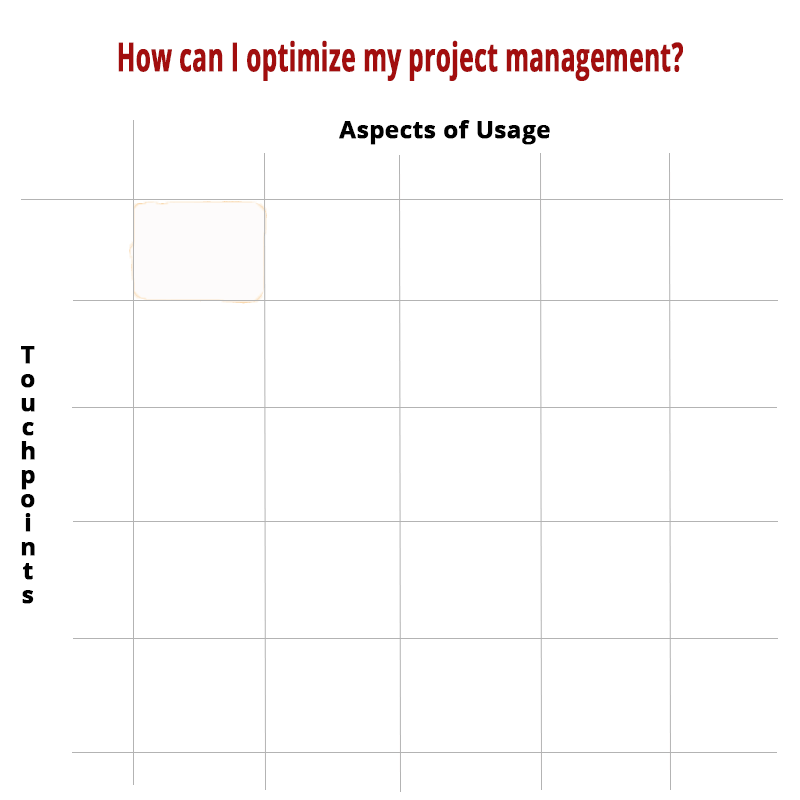
Innovation Digging can be used to develop new products and services, improve existing ones or open up new markets and target groups.
The Walt Disney Method: Dreamer, Realist and Critic
Walt Disney left us not only films but also a creativity technique. The roleplay is similar to the six thinking hats method and an alternative to brainstorming. Ideally, there are at least three participants, but it also works on your own. There are three roles:
- The dreamer comes up with ideas freely without thinking about their feasibility.
- The realist analyzes the dreamer’s ideas and looks for ways to make the seemingly impossible possible.
- The critic evaluates the result, provides constructive feedback and points out possible risks.
Ideally, each role has its own room, but three chairs in different corners of a room are enough: bright and colorful for the dreamer, equipped with tools for the realist, small and plain for the critic. After a test run in which everyone gets to know the roles, all participants go through each role in turn until one or more feasible ideas have emerged. A moderator keeps the team on topic and the criticism constructive.
Because everyone takes on every role, participants leave their comfort zone and put forward ideas they would not otherwise have suggested. The mutual checks between the roles ensure that the ideas you end up with balance quality and creativity with budget and time constraints. Disney itself founded an entire department on this basis: Walt Disney Imagineering, which develops the attractions for the Disney parks. Read more in How to Create Magic: Project Management Lessons from Walt Disney Imagineering.
Conclusion
Whether it’s freedom in an Innovation Lab or a targeted technique in a workshop: what matters is a culture in which employees are free to voice ideas and good ideas are actually implemented. The methods can be combined, for example lateral thinking to warm up, Innovation Digging to find search fields and the Walt Disney method to put ideas through their paces.
Answer to the riddle: Veronica is eight months pregnant with Tim. Tim is kicking her from the inside.